

How do I install this?
Set up your Infoseek account to get your app URL, then paste that URL into your preferred AI client.
Search Skyscanner flights from AI apps with one structured MCP call for exact routes, dates, cabin, and passenger counts.
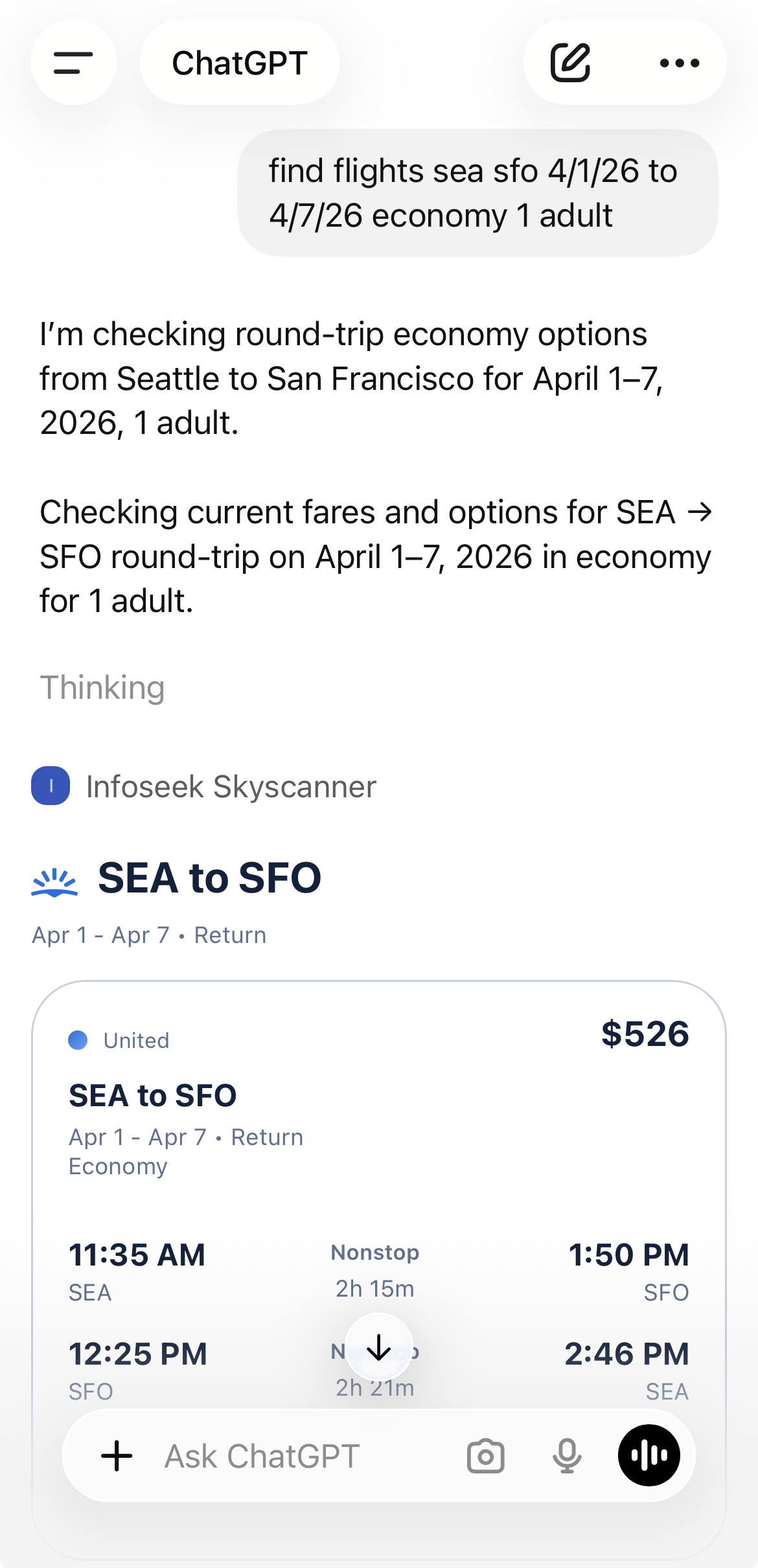
Common questions teams ask before integrating Skyscanner MCP.
Set up your Infoseek account to get your app URL, then paste that URL into your preferred AI client.
It runs exact-date flight searches using Skyscanner and returns structured results with card-ready output for AI apps and agents.
Searches are live at request time. Availability and prices can change quickly, so rerun before final booking decisions.
Required fields are from_airports, to_airports, and departure_date. Add return_date for roundtrip searches.
Yes. One-way searches use only departure_date; roundtrip searches include both departure_date and return_date.
Yes. Run this MCP from a scheduled Codex Agent or workflow and send the top results through your email step.
Most requests complete in seconds, depending on itinerary complexity and provider response time.
Yes. Any MCP client that supports tools/list and tools/call can invoke this endpoint.
The public MCP surface is intentionally simple: one Skyscanner tool takes a structured itinerary and returns both normalized results and card-shaped output for downstream UI rendering.
Tool
Use this tool for exact one-way or roundtrip Skyscanner flight searches with explicit airport codes, exact dates, cabin class, and passenger counts.
Required inputs
from_airportsto_airportsdeparture_dateUseful optional inputs
return_dateflight_classadults, childrenprefer_directsReturns
results[]countsearchcards[]The useful output is not just raw itinerary rows. The MCP returns a search summary and pre-shaped cards that can be rendered directly into agent UIs and chat surfaces.
cards[]
Best path for UI rendering. Each card already bundles airline, timing, stop, and price details in a user-facing shape.
results[]
Rawer itinerary records that are useful when you need agent-side ranking or custom transformation logic.
count
Quick signal for how many results were returned without iterating the full payload.
search
Echoes the normalized itinerary used to generate the search, which helps with grounding and auditability.
{
  "count": 2,
  "search": {
    "from_airports": ["SEA"],
    "to_airports": ["BCN"],
    "departure_date": "2026-11-11",
    "return_date": "2026-11-17",
    "flight_class": "economy"
  },
  "cards": [
    {
      "price_display": "$666",
      "deep_link": "https://www.skyscanner.com/...",
      "outbound": {
        "airline": "Turkish Airlines",
        "departure_time": "7:00 PM",
        "arrival_time": "7:20 PM",
        "stops_label": "1 stop"
      },
      "return": {
        "departure_time": "10:15 AM",
        "arrival_time": "5:05 PM"
      }
    }
  ],
  "results": [
    {
      "price_display": "$666",
      "carrier": "Turkish Airlines"
    }
  ]
}
The best way to use the MCP is one exact itinerary request per search. Normalize route, dates, cabin, and passenger counts once, then call the tool directly.
SEA and BCN.return_date when the user asked for roundtrip.cards directly or use results for custom ranking.const flights = await mcp.callTool("search_flights_sky", {
from_airports: ["SEA"],
to_airports: ["BCN"],
departure_date: "2026-11-11",
return_date: "2026-11-17",
flight_class: "economy",
adults: 1,
prefer_directs: false
});
return {
count: flights.count,
topCard: flights.cards[0],
rawResults: flights.results
};
The public tool contract is currently a direct MCP tool surface. The lambda does not advertise tool-level OAuth in the Skyscanner tool schema.
The main constraint is input quality: exact dates and explicit IATA codes are required. Flexible date and location searches are intentionally unsupported.
The MCP is designed to feed both agents and UI surfaces, with a card-oriented output path for direct rendering.
The tool contract is explicit about preserving stated return dates, which helps prevent common itinerary-loss bugs in planner pipelines.
The cards array is immediately useful for chat widgets and embedded travel result views, without a second formatting pass.
The search object gives your app a normalized record of the exact itinerary used, which is useful for follow-ups and reproducibility.
Answer exact-date route requests with Skyscanner results and UI-ready fare cards in one call.
Blend live Skyscanner search results into broader itinerary planning, hotel comparison, and trip-budget workflows.
Use one structured MCP call to enrich internal travel workflows with current route pricing and carrier options.